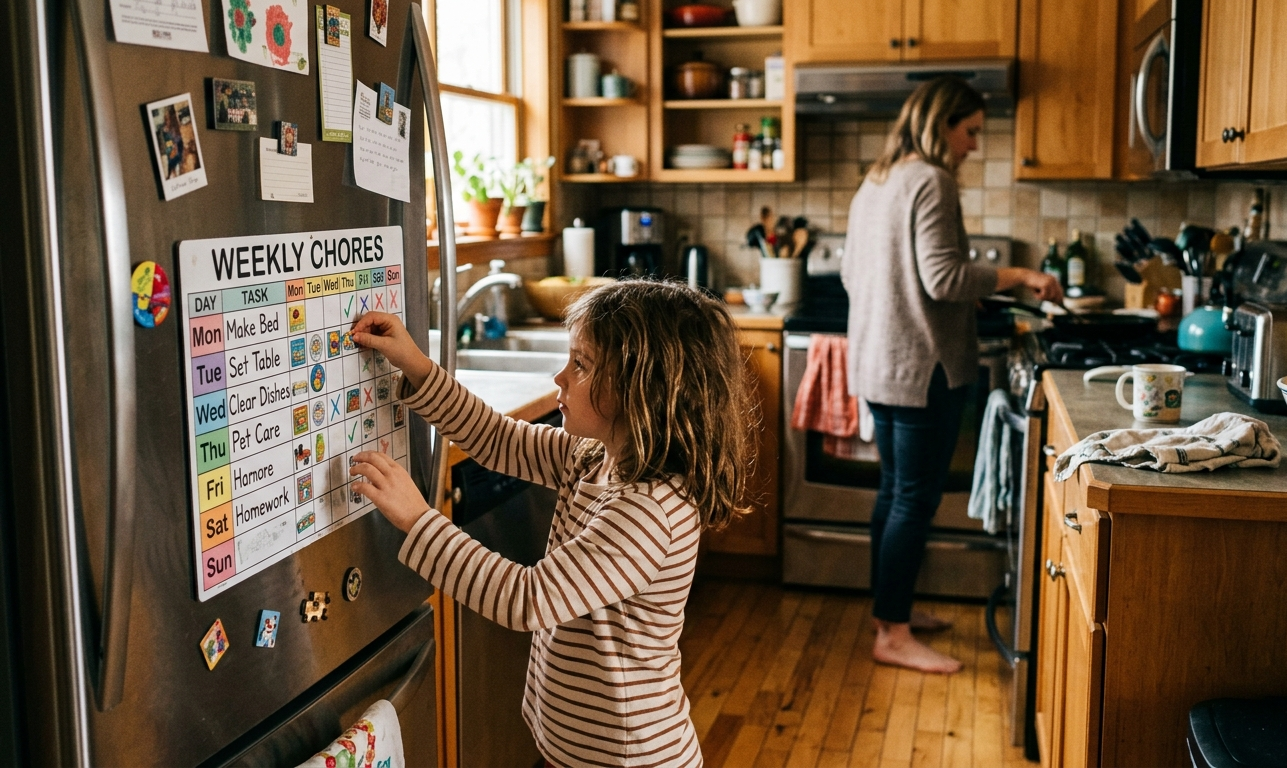
You’ve probably tried the chore chart before. Maybe it worked for a week. Maybe two. Then it quietly fell apart, and you went back to doing everything yourself because it was faster and less exhausting than the negotiation that followed every request.
Here’s the truth: the chart wasn’t the problem. The system was.
A chore chart is just a piece of paper or a whiteboard. What makes kids actually follow through is the structure around it, how chores are introduced, how expectations are set, how the system holds up under real daily pressure, and whether the tasks are actually matched to what each kid can handle.
This guide walks through exactly how to build a chore system for kids that doesn’t collapse after two weeks. It covers every age from toddlers through teenagers and how to handle the pushback that will absolutely come at some point.
As a single parent, this isn’t just about a tidy house. A working chore system gives you back hours every week, teaches your kids life skills they’ll carry into adulthood, and builds a household where everyone contributes rather than one person carrying everything.
We also recommend checking out our guide on How to Use the Cash Evelople System.
Table of Contents
As an Amazon Associate, we may earn a commission from qualifying purchases at no additional cost to you.
Why Most Chore Systems for Kids Fail (And How to Avoid Those Traps)
Before getting into the how-to, it’s worth understanding why chore systems break down. The most common reasons aren’t laziness or bad kids. There are structural problems.
Tasks are too vague. “Clean your room” is not a chore. It’s a wish. Kids need specific, concrete instructions: put dirty clothes in the hamper, put books on the shelf, make the bed. Break tasks down into small, actionable steps and demonstrate how to do each task the first few times.
The chores don’t match the child’s developmental level. Giving a six-year-old a task built for a ten-year-old sets everyone up for frustration. Giving a twelve-year-old tasks meant for a six-year-old breeds resentment and boredom. Age-matching matters enormously.
The system only lives inside the parent’s head. If the chore list exists only as a verbal reminder from you, then you become the system. You become the alarm clock, the manager, and the enforcer, which is exactly the nagging cycle every exhausted parent wants to escape.
There’s no consistency. Nagging and arguing with your child doesn’t work. We parents often get in a rut and do the same thing over and over again, expecting different results. A visible, consistent system removes the need for nagging because the expectation is clear and the reminder is always there.
It starts with too much at once. In order to change behaviors, don’t try to take on too many things at once. It becomes overwhelming to try to change too many things simultaneously. Pick the most important problem and start there.
Fix these structural issues, and you fix the system.
Step 1: Start Earlier Than You Think
One of the most important things research tells us about creating a chore system for kids is that earlier is genuinely better.
Research tells us that you shouldn’t wait too long. Dr. Marty Rossman determined that the best predictor of young adults’ success in their mid-20s was that they participated in household tasks at the age of three or four. Those who did not begin to participate until they were 15 or 16 were less successful.
Toddlers who are invited to help with simple tasks don’t see chores as punishment. They see them as participation. They want to be like the grown-ups. That instinct is incredibly powerful and worth harnessing before it fades.
The framing matters too. Think of it as inviting them into the family’s shared work, not assigning a burden. The language you use from the beginning shapes the culture of your household for years.
Step 2: Match Chores to Age and Ability
This is the most important structural decision you’ll make when creating a chore system for kids. Here’s a realistic age-by-age breakdown:
Ages 2 to 4 (Toddlers)
Toddlers are surprisingly capable and desperately want to help. The key is keeping tasks simple, physical, and immediately visible.
Two to three-year-olds can put toys and groceries away and dress themselves with help. Four to five-year-olds can help feed pets, make their beds (maybe not perfectly), and help clear the table after dinner.
Other toddler-appropriate chores include putting dirty clothes in the hamper, wiping up spills with a cloth, sorting laundry by color (this is genuinely fun for them), dusting low surfaces with a microfiber cloth, and carrying their plate to the kitchen after meals.
Don’t expect perfection. The goal at this age is building the habit and the identity of being a helper, not a perfectly made bed.

Recommended Tool to Get You Started: A low-hanging hook or bin system makes putting things away achievable for small hands and short arms. Simple Over-the-Door Hook Organizer means a toddler can hang their own backpack and jacket without needing a step stool.
Ages 5 to 7 (Early Elementary)
Kids in this age group are ready for more structured daily responsibilities. They can handle multi-step tasks with some guidance and are starting to build genuine competence.
Six to seven-year-olds can wipe tables and counters, put laundry away, and sweep floors. Beyond those basics, kids this age can set and clear the dinner table fully, water plants, help unload the dishwasher (lower rack), feed and water pets with supervision, and keep their bedroom tidy as a daily habit.
Visual chore charts work especially well at this age. Chore charts are a great motivating tool for younger kids as they help keep them on track and motivated, especially if there is a reward of some sort attached to the chart, like stickers or an allowance.

Recommended Tool to Get Started: A magnetic sticker reward chart is perfect for this group. Behavior Reward Chart with Stickers gives kids a visual record of their progress and turns completion into something tangible to be proud of. The act of placing a star or sticker after finishing a chore is a small but powerful dopamine hit for this age group.
Ages 8 to 10 (Late Elementary)
Kids this age can handle real household contributions with minimal supervision. They’re capable enough to do meaningful work and old enough to understand why it matters.
Seven to nine-year-olds can load and unload the dishwasher, help with meal preparation, and pack their own lunch for school. They can also vacuum a room, take out trash, fold and put away their own laundry, clean their bathroom sink and mirror, rake leaves, and help with grocery unpacking.
This is a great age to introduce rotating chores so they build a range of skills rather than mastering one task and resenting it.
Rotating chores weekly prevents boredom and, crucially, complaints of unfairness.
Ages 10 to 13 (Tweens)
Tweens can handle complex, unsupervised tasks. Preteens or middle schoolers can do many tasks independently and be held responsible for them without constant reminders. Many families create a chore chart or task list for their children at this age, holding their children accountable by checking once a day to mark things off the list. This helps kids learn self-reliance and to be responsible for themselves when no one is looking.
Tween-appropriate chores include washing dishes by hand, cooking simple meals or helping with full dinner prep, cleaning bathrooms top to bottom, doing their own laundry start to finish, mopping floors, changing their bed sheets, and helping with grocery shopping.
Give tweens some agency in the chores they take on. Giving preteens a say in chore division means less protest. “Which two jobs do you want this week?” works better than “Here’s your list.”

Recommended Tool to Get Started: A whiteboard chore board that lives on the fridge works well for this age because it’s visible to the whole household and removes the need for daily verbal reminders. Magnetic Dry Erase Chore Board for Fridge is reusable week after week and doubles as a general family schedule board.
Ages 14 and Up (Teens)
Teens are usually able to do most household chores with minimal supervision. Teenage years are a crucial time to teach the importance of independence and responsibility. This will ensure that your kids are well-prepared for adulthood and will be able to look after themselves when they leave home.
Teens can and should be doing laundry independently, cooking full meals for the family, cleaning the entire kitchen, deep-cleaning bathrooms, vacuuming the whole house, mowing the lawn, babysitting younger siblings for short periods, and managing their own schedules around household responsibilities.
Teens might grumble, but link chores to privileges, including Wi-Fi access, and suddenly things get done. This isn’t punishment. It’s a realistic training ground for how the adult world works: responsibilities come before rewards.
Step 3: Design Your Visible System
The single most important structural feature of a working chore system for kids is that it lives somewhere visible in the house, not in anyone’s head.
When the expectation is written down and publicly displayed, you stop being the reminder. The chart is the reminder. This is the shift that reduces nagging from a daily battle to an occasional check-in.
Here are the three most effective formats and the Amazon products that support each:
Option 1: Magnetic Dry Erase Chore Board (Best Overall)
A dry erase magnetic board on the fridge is highly visible, fully customizable, and endlessly reusable. You write in chores each week, kids check them off or erase them when done, and you reset at the start of each new week.
This works for all ages but is especially effective for families with multiple kids at different stages, since each child can have their own column.

Coolcho Large Magnetic Chore Chart for Kids and Adults – a 16.5 x 13.5 inch dry erase board that mounts to the fridge with a strong magnetic backing. Plenty of space for multiple kids, comes with 5 markers and an eraser, and the thick 0.9mm board won’t peel or bubble at the edges the way cheaper options do.
Option 2: Sticker Chart System (Best for Ages 4 to 9)
For younger kids who need visual motivation and a tangible reward loop, a sticker-based chore system for kids works exceptionally well. Each completed chore earns a sticker or star. When the row or week is full, a small reward follows.

Behavior Reward Chart System with 2800 Stickers – a pad of 26 individual chore charts plus thousands of stickers. The chart itself is disposable, so there’s no erasing or resetting, just peel off the completed sheet and start fresh. Great for kids who respond to visual completion.
Option 3: Slider Routine Chart (Best for Kids with ADHD or Routine Needs)
Some kids do best with a task-by-task visual checklist where they physically move a slider or flip a card when each step is done. This format is especially helpful for kids who struggle with executive function, ADHD, or transitioning between tasks.

Chore Chart with 10 Sliders and Magnetic Marker – a simple checklist board where kids move individual sliders from open to checked as they complete each task. No magnets to lose, no stickers to run out of. Satisfying for systematic thinkers and kids who need step-by-step structure.
Option 4: Wooden Framed Wall-Mounted Chart (Best for Older Kids and Teens)

Teens often reject anything that feels babyish, so a clean, minimal wall-mounted whiteboard feels more like an adult planning tool than a kids’ chart. Mount it in a hallway or common area rather than the fridge, and it becomes part of the household operating system rather than something childish.
Magnetic Whiteboard Chore Chart with Wood Frame – a wood-framed magnetic whiteboard designed to hang on the wall. Clean design that doesn’t look like a children’s toy, which matters more than parents realize once kids hit 11 or 12.
Step 4: Launch the System the Right Way
How you introduce the chore system for kids determines whether it sticks. A low-key, clear launch beats a big, dramatic announcement every time.
Sit down with your kids when everyone is calm, not at the end of a stressful day. Explain that the household is a team and everyone on the team has a role. Show them the chart. Walk through each chore. Make sure every task is understood, not just acknowledged.
We don’t expect our kids to know how to do things like tie their shoes or ride a bike without being taught first, but somehow we have the expectation that they will just pick up on how to complete household chores without much effort on our part. Teach them first.
This means actually demonstrating how to wipe down a counter, how to sort laundry, or how to sweep properly. The first week of any new chore should involve doing it together at least once, so the standard is clear.
You will get the maximum amount of complaining if you wait until the day of to tell them what chores to do. Better results come when you go over the next day’s plan before bed. A brief evening check-in, “tomorrow you’ve got the dishwasher and feeding the dog, just a heads-up,” removes the surprise element that triggers resistance.
Step 5: Tie Chores to Daily Routines, Not Random Reminders
The most reliable chore system for kids is anchored to existing daily routines rather than floating free as separate events. When a chore is always done right after dinner, or always before screen time, it becomes a habit rather than a negotiation.
Build chore time into the structure of each day: morning routine (make bed, put away pajamas), after-school (empty backpack, take out anything that needs washing), after dinner (clear table, load dishwasher), and before bed (tidy bedroom, set out tomorrow’s clothes).
Establish in your household the expectation that responsibilities come before perks. Do chores before enjoying things like screens or other privileges. Work and reward are related. This is not a punishment framework — it’s a realistic representation of how adult life operates, introduced early enough to feel natural.
Time limits are a good way to get kids to comply. “The kitchen needs to be done in 20 minutes” creates a cost associated with foot-dragging without requiring you to nag. You keep time instead of repeating yourself. If the task isn’t done, a consequence follows automatically.
A simple kitchen timer works fine for this, or a visual countdown tool for younger kids.

Time Timer Visual Timer for Kids – a countdown timer that displays time visually as a colored disk shrinking away, which is much more concrete and motivating for younger kids than a digital number counting down.
Step 6: Handle Pushback Without Losing Ground
Resistance to a chore system for kids is normal, predictable, and not a sign your system is failing. Here’s how to handle the most common situations.
The “I’ll do it later” loop. Set a specific time window and a specific consequence if the window passes. “The trash needs to go out before 7 pm. If it doesn’t, no screens tonight.” Then follow through, calmly and without lecture. The beauty of this system is that you’re not constantly nagging; you’re just keeping time. The next night, you can say: “Let’s not repeat what happened last night.”
“That’s not fair, they got an easier chore.” Rotating chores on a weekly basis solves most fairness complaints before they start. When everyone takes turns with every task over time, the rotation itself becomes the fairness mechanism.
“I don’t know how.” This one is often genuine, not an excuse. Go back to demonstrating the task rather than repeating the instruction. Be specific and clear. Break tasks down into actionable steps and demonstrate how to do the task the first few times.
The teen who flat-out refuses. Connect chores to privileges rather than punishments. Wi-Fi access, car keys, having friends over, staying up later. These are privileges that come with being part of a functioning household. A teen who understands that clearly is far more cooperative than one who sees chores as arbitrary parental demands.
A Note on Rewards and Allowance
There are two schools of thought here, and neither is wrong. Some families tie allowance directly to chore completion. Others keep allowance and chores separate, treating chores as a basic family contribution and allowance as a separate financial education tool.
For single-parent households on tight budgets, a low-cost chore system for kids that doesn’t involve cash works well. A sticker chart with a small reward at the end of a full week (a chosen movie, a special dessert, an extra 30 minutes of screen time) keeps motivation high without straining your budget.
What matters more than the reward structure is consistency. A system with no rewards but clear follow-through on consequences will outperform a generous reward system that parents don’t enforce.

Kids Reward Token Board – a simple token-based reward system where kids earn physical tokens for completed chores and trade them in for agreed-upon rewards. Works for ages 3 through 10 and keeps the reward tangible and visible.
Mistakes to Avoid After Launching a Chore System for Kids
Doing the chore yourself when it doesn’t get done. This teaches kids that non-compliance works. If the consequence is that you eventually do it anyway, they’ve learned exactly the wrong lesson. Follow through on consequences instead.
Accepting partial completion. If “clean the bathroom” means wiping the mirror and ignoring the toilet, that’s not done. The first few times a chore isn’t done to standard, walk through it together and re-demonstrate. After that, the standard is established, and partial completion gets partial credit, not full.
Abandoning the system after a hard week. Every chore system for kids goes through rough patches: school stress, illness, and disrupted routines. A skipped week doesn’t mean the system failed. Reset, acknowledge the disruption, and restart. Consistency over months matters far more than perfection in any given week.
Never updating the chores as kids grow. A system built for a seven-year-old needs to change by the time they’re ten. Revisit the chore system for kids every few months as abilities and enthusiasm change. Assign a brief family check-in each season to review what’s working and adjust responsibilities to match each child’s current capabilities.
The Bottom Line About Creating a Chore System for Kids
A chore system for kids that works isn’t about finding the perfect chart or the magic incentive. It’s about matching tasks to ability, making expectations visible, anchoring chores to existing routines, and following through consistently enough that kids understand the system is real.
For single parents, a functioning chore system for kids is not a nice-to-have. It’s a practical survival tool that frees up your time, reduces your mental load, and raises kids who are genuinely capable of contributing to a household, which is one of the most valuable things you can teach them.
Start small. Pick one or two chores per kid. Get the right chart on the fridge. Teach the tasks properly. Hold the line on follow-through. And give it more than two weeks before you decide it’s not working.
It works. It just takes longer to build than most parents expect.
Was this article helpful? Read one of these next:


Leave a Reply